The Problem:
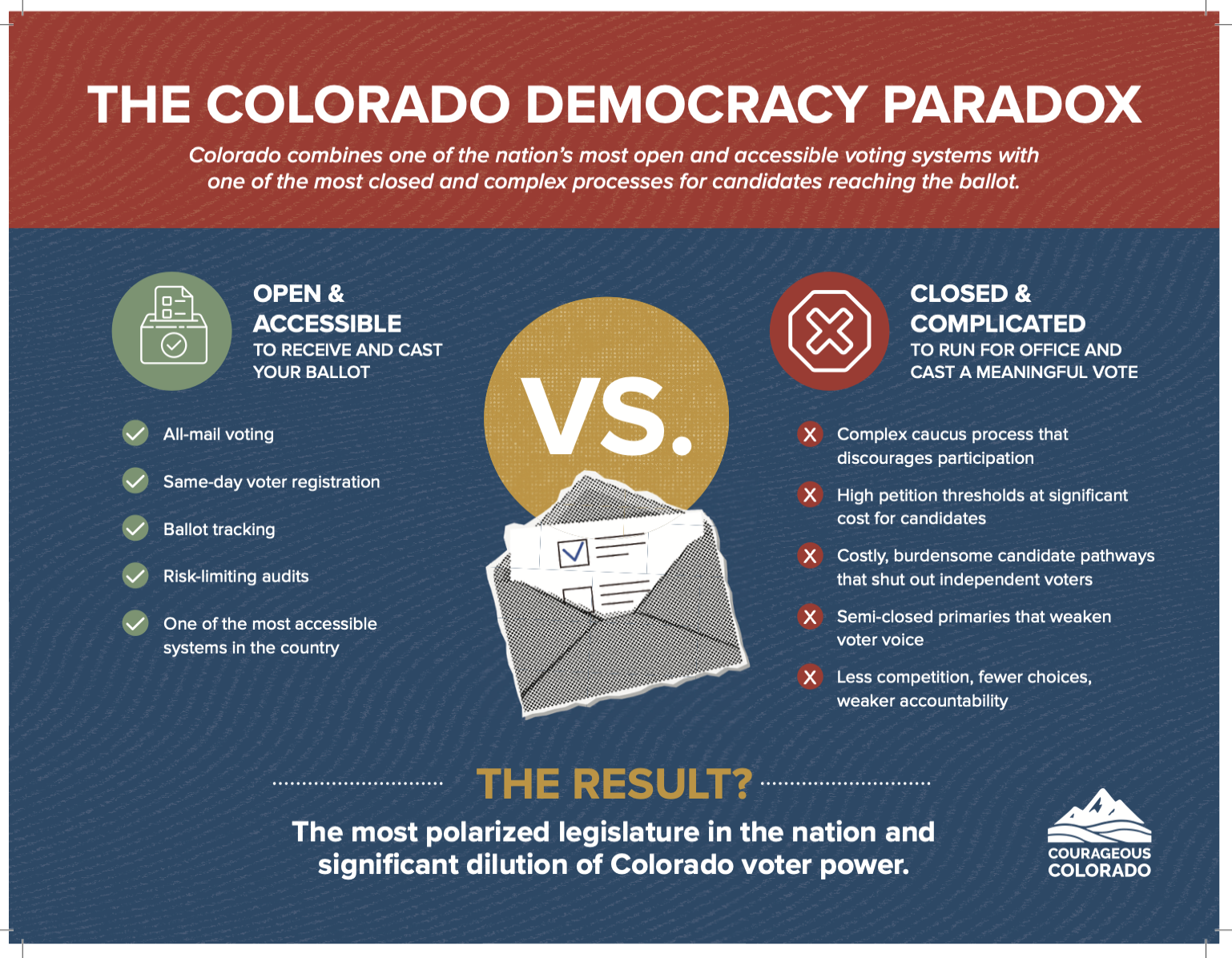
The Colorado Democracy Paradox
Over the past year, Courageous Colorado traveled across the state listening to residents, local leaders, organizers, educators, business voices, and community builders about the future of Colorado’s democracy. From rural communities on the Eastern Plains and Western Slope to rapidly growing suburbs and urban neighborhoods, a common theme emerged: people believe in Colorado, but many no longer believe the political system is fully working for them. That insight, combined with our research, coalition conversations, and analysis of national and state trends, led us to identify what we now call the Colorado Democracy Paradox.
Colorado has created one of the most open and accessible voting systems in the country, yet the systems that shape who can compete, govern, and meaningfully influence outcomes often remain closed, complicated, and dominated by narrow political incentives. In too many places, people feel invited to participate in democracy while simultaneously feeling shut out of political power.
The consequences of this paradox are increasingly visible: most legislative races are effectively decided before the general election, meaningful competition has declined, and political incentives reward ideological rigidity over responsiveness and courage. Research from the Unite America Institute found that 78% of Colorado state house races lacked meaningful competition, while fewer than 1 in 5 Colorado voters cast what researchers define as a “meaningful vote” in determining legislative outcomes. At the same time, Boris Shor and Nolan McCarty’s research (Two Decades of Polarization in American State Legislatures) identified Colorado as now having the most polarized state legislature in the nation.
For Courageous Colorado, this is not simply a political problem — it is a systems challenge that affects trust, belonging, problem-solving, and the future of the state itself. It also echoes another paradox the state deals with: in a state celebrated nationally for educational attainment and innovation many communities still struggle to access opportunity, mobility, and representation. Our work exists to help Colorado move beyond these contradictions and build systems worthy of the people who call this state home.